AI agents can now write code, extract knowledge and drive equipment well enough to be useful. Most teams that try them in production hit the same wall, and it is rarely the model’s ability. It is trust. Who checked this change? Who allowed that action? What exactly happened at 02:14 last Tuesday?
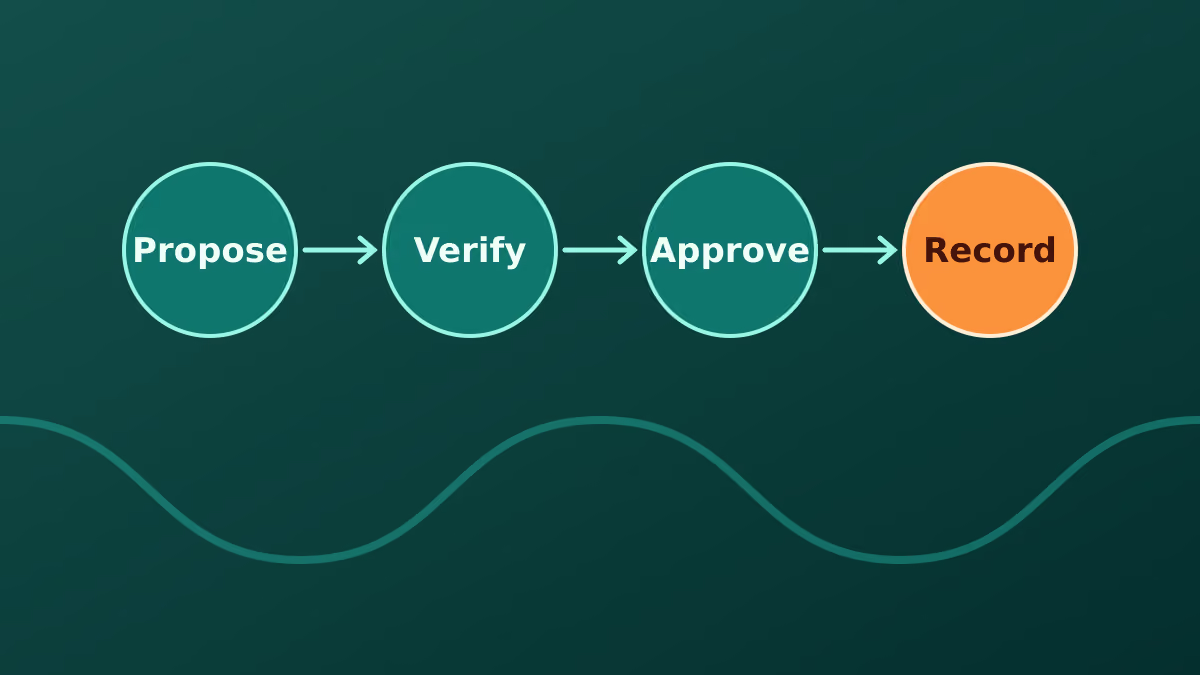
At Cosinara we build every system around one loop with four steps.
1. The agent proposes
An agent’s output is a proposal: a patch, a set of extracted facts, a command for a machine. It is never applied directly. Treating output as a proposal changes the architecture. Agents work in isolated workspaces, under hard budgets, with only the access their task needs.
2. The system verifies
Agents are confident narrators, so “the tests pass” is a claim and not evidence. The system runs the tests itself, checks the result against policy, and where it matters, asks a solver. For the rules that must never be broken, we write formal specifications and prove them.
3. A person approves
Verification tells you a proposal is valid. It does not tell you it is wanted. Anything consequential waits for an explicit approval from the right person, with deadlines and escalation. A voice command or a chat message can ask, but it cannot approve.
4. The action is recorded
Every action is logged together with the evidence that justified it and the rule that allowed it. That record lets you explain a decision months later, replay it, or roll it back. It is also what your security and compliance reviewers will ask to see.
Why the loop matters more than the model
Models change every few months, and the loop does not. If you build verification, approval and audit as part of your system, not as features of one vendor’s agent, you can switch models without rebuilding the controls you depend on.
This is the design centre of everything we make, whether it is Orbit Harness for coding agents, Hornbeam for verified knowledge, or Cosinara Operator for machines on the shop floor.
If you are trying to get an agent past the pilot stage, we would like to hear about it.